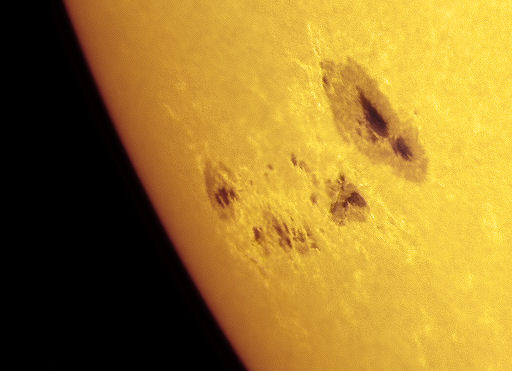
The sun has been very quiet for the past decade. This is not normal.
Normally it fluctuates on an eleven year cycle. But not anymore.
Sunspots, like the one pictured above are the subduction zones on the suns surface. The sun is made of plasma, a superconducting, superhot phase of matter where the majority of the atoms are ionised having lost at least one electron. In a normal sun, or the one we have become accustomed to, the hot plasma rises slowly from the hotter lower layers in cells. At the edge of the cells the plasma pluges downwards and is reheated. At the solar maximum these black spots form and the relatively cooler plasma migrates deeper.
This circulates more hot plasma to the surface in the cells. This gives a sun that gives of marginally more heat.
What is abnormal is what has been happening during the last few years. The sun was supposed to be in solar maximum in 2008 but was remarkably clear. It has had a very low number of sunspots since.
This spot cluster pictured above is the biggest for many years.
What will happen next? There are three expected outcomes:
1) The sun will limp along with these unpredictable symptoms, life will continue as it is. It will either end up "normal" again or switch to the following 2 modes.
2) The lack of sunspots could be indicative of a lack of heat being generated from underneath. This will result in a cooling of the earth due to less heat. There earth would also be cooled due to the reduction in the solar wind which blows away most of the cosmic particles that seed our clouds. More seeding particles, more clouds and less sunlight getting to the surface.
3) The lack of sunspots could be due to a distruption in the normal circulation of plasma. Over the last 10 years the heat could be building up. This much higher heat within the sun could convect to the suface in a vast flare. Normally flares are short lived affairs and most often do not occur when the earth is in the way. If this predicted, long-lived flare occurs then the sun will become a sprinkler spewing radiation on a previously unseen scale. The sun would spew its radiation from its equator into the ecliptic plane where our own earth spaends all its time. Once hit we could then count on getting hit again in 24 days time as the sun rotates around to have another go, and maybe again in another 24 days...
So, having another ice age is survivable. We came out of our last one 11715 years ago. The normal state of the earth is "ice age". Enjoy your warmth and easily found fresh water while you can. In our ice planet the oceans are hypersaline and tiny. The sea level can drop 1500m. All the excess water ends up as polar ice cap and the rain guage stays dry. Makes global warming look like a GOOD thing!
The effect of the earth getting strafed with a solar flare can be guaged by the occasions when a small bit of the planet got hit by a quick blow. In 1859 there wasn't much in the way of electric technology around when the earth got hit by one. It caused a few telegraph stations to catch fire. Link. Another hit happened in 1989 and affected Canada. Link. These were "minor". If the sun behaves as per scenario 3 then the whole earth will be affected. As well as widespread damage to electrical items there would be the danger of penetrating ionising radiation similar to what you would get in a nuclear war. A minor plus would that it could be safe to venture out of your radiation shelter at night time. The auroras would make it worth the risk.
Get yourself a radiation meter and maybe some snowshoes too. Just don't tell anyone or else they will think you are crazy. You don't want anyone to think you are crazy now, do we?

No comments:
Post a Comment